


Understanding Integrated Business Banking Solutions and Their Impact on MSMEs




Experience the all-new Kotak Netbanking
Simpler, smarter & more intuitive than ever before


Quick Help
Frequently Asked Questions
Show More
For Kotak Bank Customers
For Kotak811 Customers
Experience the all-new Kotak Netbanking Lite
Simpler, smarter & more intuitive than ever before. Now accessible on your mobile phone!
Yes, in many cases. As per Reserve Bank of India (RBI) guidelines, banks cannot insist on collateral security for loans up to ₹10 lakh extended to Micro and Small Enterprises. Beyond this limit, collateral-free lending is facilitated through government schemes such as the Credit Guarantee Trust for Micro and Small Enterprises (CGTMSE), which allows eligible MSEs to access collateral-free credit up to ₹10 crore under the enhanced cover introduced in Budget 2025-26. Eligibility and approval remain subject to the bank's credit assessment and prevailing scheme terms.
A current account is designed for high-frequency business transactions — there is no cap on the number of daily transactions, and it supports facilities like overdraft, cheque books, bulk payments, and trade services. A savings account, by contrast, limits transaction volumes and does not typically offer these business-grade features. Businesses, whether sole proprietorships, partnerships, or companies, are generally required to operate through a current account for their primary business flows.
While exact requirements vary by bank, businesses typically need proof of business activity (GST registration certificate, Udyam Registration Certificate, trade licence), identity and address proof of the proprietor or directors, and the PAN card of the business entity. For companies and Limited Liability Partnerships (LLPs), a Certificate of Incorporation and the Memorandum of Association (MoA) or LLP Agreement are also required. It is advisable to check with the bank directly for the complete and current document checklist.
Disclaimer: This Article is for information purpose only. The views expressed in this Article do not necessarily constitute the views of Kotak Mahindra Bank Ltd. (“Bank”) or its employees. The Bank makes no warranty of any kind with respect to the completeness or accuracy of the material and articles contained in this Article. The information contained in this Article is sourced from empanelled external experts for the benefit of the customers and it does not constitute legal advice from the Bank. The Bank, its directors, employees and the contributors shall not be responsible or liable for any damage or loss resulting from or arising due to reliance on or use of any information contained herein




Key Takeaways
Running a small business in India means managing a lot of moving parts — supplier payments, customer collections, payroll, GST filing, and short-term credit needs — often through separate tools or accounts.
For most MSMEs, this fragmentation quietly costs time and money. Delays in collections slow down payments. Lack of real-time cash flow data makes credit decisions harder. And switching between platforms to reconcile accounts adds unnecessary complexity to daily operations.
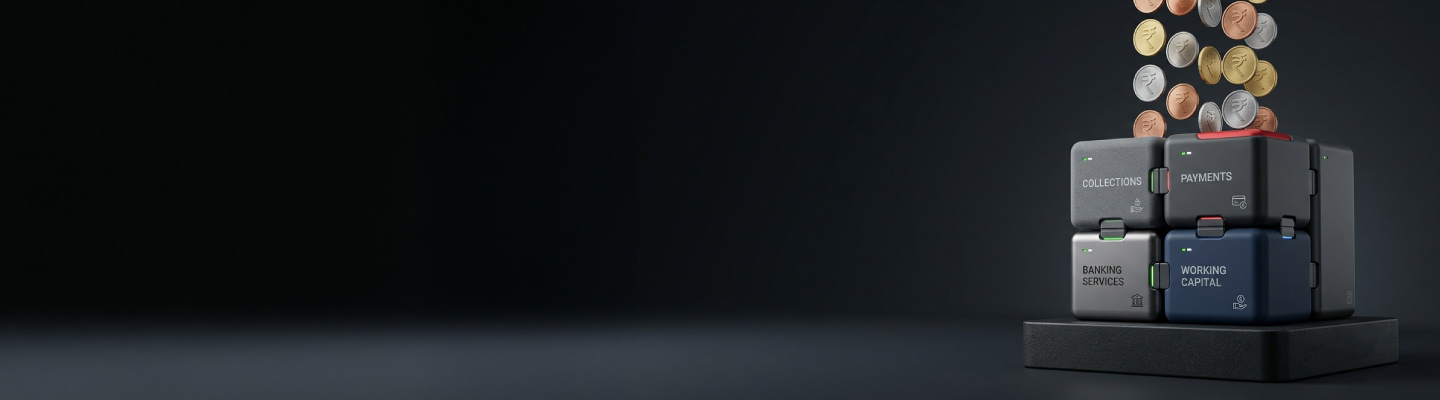
A bundled business banking solution addresses this directly. By consolidating four core functions — banking, payments, collections, and credit — into one platform, MSMEs can reduce operational friction and manage their finances from a single view.
Table of Contents
What Does an integrated Business Banking Actually Mean?
An integrated business banking solution is not a single product. It is an integrated banking framework that combines four functions an MSME needs on a daily basis:
For MSMEs, this is a practical shift. Managing four separate banking relationships — one for the current account, one for a payment gateway, a third for collections, and another for credit — is inefficient. A bundled approach removes that complexity.
When these four components sit within the same banking relationship, the data generated across each function becomes useful. Your collections history informs credit eligibility. Your payment patterns reveal where cash is tied up. Your account balance drives real-time decisions — not end-of-month reports.
How Do Payments and Collections Work in a Bundled Banking Setup?
For most MSMEs, payments and collections are the daily pulse of the business. Delays on either side create cash flow gaps.
On the payments side, a bundled banking setup allows businesses to:
On the collections side, the shift to digital is even more impactful:
Why Does Credit Access Matter More When It Is Linked to Your Account?
Credit has historically been one of the biggest pain points for MSMEs in India. Collateral requirements, limited credit history, and documentation burdens have kept many businesses out of formal credit channels.
When credit is embedded within a business banking platform, the barriers reduce significantly.
How account-linked credit works differently:
What this means for an MSME:
A small manufacturer waiting on receivables from a large buyer does not need to approach a new lender or submit a fresh application. If their banking relationship already captures their transaction history, working capital can be accessed within the same platform — quickly, and within the limits already assessed.
How Does ERP Integration Change Day-to-Day Business Operations?
As MSMEs formalise and grow, many adopt Enterprise Resource Planning (ERP) or accounting software to manage inventory, billing, and compliance. The gap between the ERP and the bank account has traditionally required manual effort — downloading statements, matching entries, and updating records.
ERP-integrated business banking closes this gap.
Key operational benefits:
This matters most for businesses that have outgrown spreadsheets but are not yet large enough to run a full finance team. A trading company with 50–100 monthly invoices, for instance, can significantly cut reconciliation time when the banking platform talks directly to their accounting software.
Conclusion
For MSMEs, the move from fragmented banking to a bundled solution is not just about convenience. It is about operational control. When payments, collections, credit, and account management work together, businesses spend less time on administrative tasks and more time on growth.
An integrated business banking solution gives small and medium enterprises a clearer view of their cash position, faster access to working capital, and reduced reconciliation burden — all within a single, compliant banking framework.
Kotak Mahindra Bank's business banking offerings are built with this in mind. Whether you run a manufacturing unit, a trading firm, or a services business, Kotak brings together the banking infrastructure that supports day-to-day operations and longer-term financial management — with the backing of a trusted institutional relationship and RBI-compliant products designed for the MSME segment.
You have already rated this article
OK