


Difference Between PIO & OCI: A Complete Guide




Experience the all-new Kotak Netbanking
Simpler, smarter & more intuitive than ever before


Quick Help
Frequently Asked Questions
Show More
For Kotak Bank Customers
For Kotak811 Customers
Experience the all-new Kotak Netbanking Lite
Simpler, smarter & more intuitive than ever before. Now accessible on your mobile phone!
No, PIO cards became invalid in 2019, but the date has been extended till December 2025. All former PIO holders are automatically eligible for OCI cards and should get their PIO cards converted to OCI cards.
OCI offers lifetime validity and unlimited stay duration in India while PIO was limited to 15 years with additional requirements for stay greater than 180 days. OCI card holders are also treated at par with NRIs in multiple areas, according them greater rights than PIO card holders.
Yes, OCI holders can purchase residential and commercial properties in India but cannot own agricultural land, plantations, or farmhouses.
Disclaimer: This Article is for information purpose only. The views expressed in this Article do not necessarily constitute the views of Kotak Mahindra Bank Ltd. (“Bank”) or its employees. The Bank makes no warranty of any kind with respect to the completeness or accuracy of the material and articles contained in this Article. The information contained in this Article is sourced from empanelled external experts for the benefit of the customers and it does not constitute legal advice from the Bank. The Bank, its directors, employees and the contributors shall not be responsible or liable for any damage or loss resulting from or arising due to reliance on or use of any information contained herein



Introduction
Many NRIs often ask about the difference between a PIO card and an OCI card. Both were introduced to make it easier for people of Indian origin to visit or invest in India, but the rules have changed over time.
The government stopped issuing PIO cards on 9th January 2015 and merged the scheme with the OCI programme. Today, only OCI cards are issued but many still hold old PIO cards—they will have to switch to an OCI card as per the current deadline—December 31, 2025.
This guide breaks down the differences in simple terms, so you know where you stand.
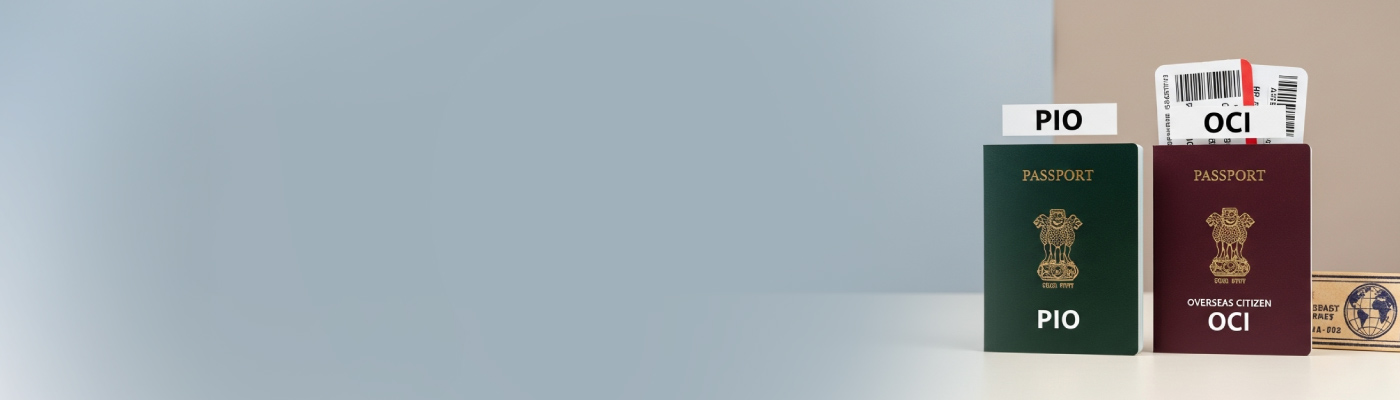
What Is the Difference Between PIO and OCI Status?
Understanding PIO
PIO stands for Person of Indian Origin.
This status was introduced in 1999 for foreign citizens to trace their Indian ancestry. PIO refers to a foreign citizen (except a citizen of Pakistan, Bangladesh, China, Afghanistan, Iran, Sri Lanka, Bhutan and Nepal) who previously held an Indian passport or whose ancestors were Indian citizens.
The PIO meaning encompassed anyone whose parents, grandparents, or great-grandparents were born in India or were eligible to become Indian citizens. Spouses of Indian citizens were also eligible for PIO status.
Understanding OCI
OCI stands for Overseas Citizenship of India.
Introduced in 2005, the OCI card offers more comprehensive benefits than the previous PIO system. OCI refers to a foreign national who was an Indian citizen or eligible to become an Indian citizen on or after 26th January 1950 or belonged to a region that became part of India after 15th August 1947.
Differences Between PIO and OCI
Aspect
PIO (Person of Indian Origin)
OCI (Overseas Citizen of India)
Status
Old Scheme: no longer issued
Active Scheme – currently valid and issued
Card Validity
Valid for 15 years
Lifetime validity
Visa Type
Multiple entry visa for 15 years
Lifelong multiple entry visa (always keep your passport with you when visiting India)
Registration with FRRO
Required if stay in India is more than 180 days
Not Required for visit to India
Rights
Limited Rights (education, property, etc.)
Treated at par with NRIs for areas like education, property purchase, etc. (except political rights)
Please note: The Government of India no longer issues PIO cards. Individuals can only apply for OCI cards henceforth. Existing PIO card holders are automatically eligible for an OCI card, and should get their PIO card converted to an OCI card by 31st December 2025.
Conclusion
Since 2015, the PIO card has been merged with the OCI programme. Only OCI cards are issued today, and they provide lifetime validity along with benefits such as visa-free travel to India, property investment rights, and access to financial services.
Ready to make your India journey smoother? Kotak's specialised NRI services help you manage cross-border finances effortlessly, from money transfers to NRI investment planning. Our dedicated relationship managers understand the unique needs of OCI holders and are here to guide you through seamless account opening and financial planning.
You have already rated this article
OK